
Houston Previous Residents by Era
Different sources answer different questions about previous residents of a Houston address. The deed chain establishes transfers of an interest in land. Directories and census schedules can connect people to an address at a date. Maps describe the place, while permits, newspapers, funeral material, and probate files can supply events around it. Begin with the newest reliable record, then use the table to select the next older source rather than expecting one database to cover every decade.
| Houston source | Period represented | Access channel | Address-history value |
|---|---|---|---|
| County Clerk real-property index | Online images from about November 1, 1960; older land records through other channels | Online portal, Clerk office, warehouse, archives, microfilm, or request | Transfers, liens, restrictions, plats, and legal descriptions. |
| TSLAC deed microfilm | 1837-1886 listed | TSLAC in Austin or interlibrary loan | Early deed books plus direct and reverse indexes. |
| Houston city directories | Digital 1866-1923; physical run through 1986 | HPL, Clayton, ContentDM, and licensed databases | Dated names, addresses, occupations, and street guides. |
| Criss-cross directories | 1925-current described, with exact gaps to verify | HPL and local collections | Address-first occupant or owner leads. |
| Federal census | Public through 1950 | NARA and approved library databases | Household composition at census dates. |
| Houston permits | Online sold history about three years; complete history by request | Permit portals and city public-information route | Construction chronology and named filing fields when public. |
For a post-1960 transfer, begin with the County Clerk index and the matching legal description. For an earlier owner, pivot to the Clerk's warehouse books, central microfilm terminal, Harris County Archives, TSLAC microfilm, or a records request. For who lived here before, use the address-first directory and census layers after the deed path gives an era to test.
The Harris County Clerk describes land records from the Republic of Texas period to the present, but availability changes by date and document type. Online real-property images are generally watermarked, while certified paper or electronic copies follow a different order path. When a historical question depends on legal effect, retain the instrument details and ask the Clerk for the needed copy rather than treating a screen image as the final record.
Houston Previous Residents Deed Trail
The backward trail starts with the current parcel record at HCAD Property Search, which offers account, property-address, and owner-name routes. Use it to capture the exact legal description, account, parcel location, and current owner. The appraisal card is not a deed, and its mailing address may be different from the property location. Next, use the Harris County Clerk Real Property Search to find the current owner as grantee and match the subdivision, lot, block, abstract, tract, or unit.
- Record the HCAD account and the legal description, not just the modern street address.
- Find the present owner as grantee in the real-property index and inspect the deed that matches the description.
- Read the seller, or grantor, on that deed, then search that seller as grantee in an earlier period.
- Repeat the sequence, saving file number, date, instrument type, book or page when shown, every party, and the legal description.
- When the online image range ends, continue through the County Clerk office, warehouse books, central microfilm terminal, archives, TSLAC, or a records request.
- Grantor and grantee
- The grantor transfers an interest. The grantee receives it. Neither term alone proves who lived at the property.
- Chain of title
- The sequence of transfers connected by the same property description.
- Legal description
- The subdivision, lot, block, abstract, tract, unit, or survey wording that identifies the land more reliably than a changing street label.
A chain can fork. A deed may convey part of a tract, identify a trustee, or use a correction, release, lien, deed of trust, or restriction. Those instruments do not necessarily change ownership. The County Clerk page also distinguishes free watermarked online images from certified copies. Use the portal as the index route, then use the office, mail procedure, or records request when the document or certification needed is unavailable online.
Note: A release, lien, deed of trust, restriction, or correction can appear in the index without transferring ownership.
Houston Resident Address Clues
A modern address may fail in an older deed search because the recorded document relies on the legal description rather than the street name. A transfer can cover only part of a tract, identify a trustee, or use a survey and abstract instead of a numbered street. The owner-name route also needs care: an HCAD mailing address is for tax notices and is not confirmation that the owner occupied the parcel.
The most dependable Houston sequence is parcel address to HCAD account, account to legal description, legal description to deed, then seller as next grantee. That local search habit is especially useful when the address, subdivision, or municipal context changed. It is more reliable than repeatedly changing the spelling of one modern street name.
The Harris County Clerk public-records page explains the office's broader access routes for historic land records and copies.
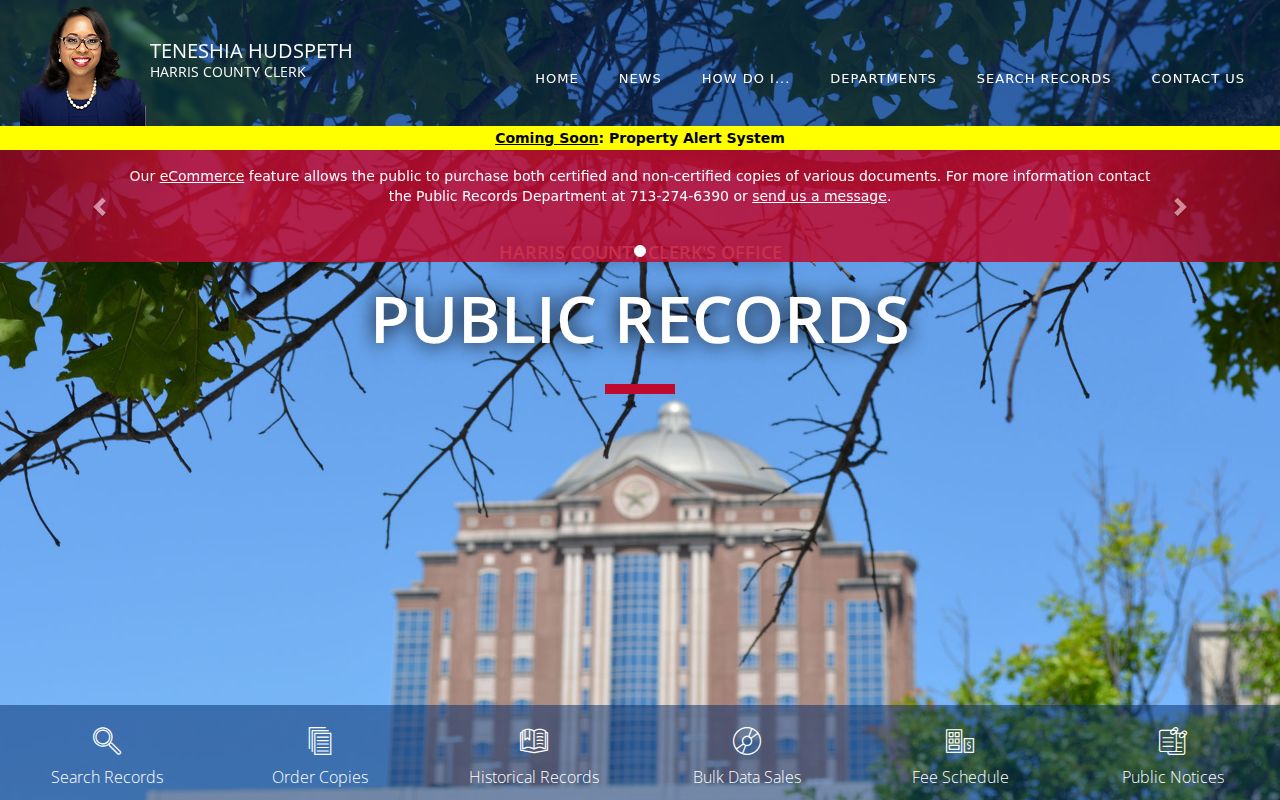
The Clerk route matters when a previous-residents trail reaches a record that is not in the online image range or needs a certified copy.
Houston Previous Residents in Directories
Deeds identify transfers, but they do not always identify the people who occupied an address. Houston city directories can provide dated name and address leads, and criss-cross volumes reverse the normal lookup by starting with the street address. The collections themselves belong to the Houston city directory collection; use the resulting volume and page as the proof for a particular year, not a summary from another database.
Pair a directory volume with the nearest federal census. The census can show household composition at a census date, while a directory helps fill the years in between. Start with the street or householder section, check the alphabetical section, and write down spelling variants, the date, and the address as printed. A listing can reflect a business, boarder, or head of household, so it should not be stretched beyond what it says.
- Choose a directory year near the deed transfer or the known family event.
- Search the address-first and name-first sections, retaining the full citation.
- Move forward or backward through nearby volumes and note changes in address or spelling.
- Pair the period with the closest released census schedule.
- Use a newspaper, funeral record, probate file, or certified vital record to check a move, death, or inheritance.
Lawful use. Houston house-history research is for family history, property curiosity, and estate questions. A dated record is never permission to pursue, threaten, or repeatedly contact a living person.
Houston Residents on Maps
The City of Houston historic-preservation house-history guide joins city directories, old telephone books, census schedules, Sanborn maps, newspapers, plats, and permits. Sanborn sets at HPL include 1885, 1890, 1896, 1907, 1924, and 1955. The University of Texas and the Library of Congress hold overlapping complete and partial Houston runs. A Sanborn map may show a structure footprint, material, use, or nearby buildings, but it does not replace title evidence.
Permits add a construction or alteration timeline. The older sold-permit form searches by date range, address, ZIP, buyer name or address, applicant, project number, valuation, permit type, and building use. Its online history is limited to roughly the prior three years. For a complete record trail, use the City of Houston public-information process instead of assuming the web form is the full archive.
Houston 311 can also preserve a service-request chronology tied to a case number and often an address or location. It is a neighborhood-history lead, not proof of who occupied the property. When an online result is incomplete, the city offers the counter, telephone, and written public-information routes for records held by the correct custodian. Ask for existing permits, dates, or case material rather than a newly created history of an address.
Historic Houston Addresses Change Names
Houston's address story includes renamed streets, subdivisions, annexation changes, and postal labels that do not always match city limits. Dowling Street became Emancipation Avenue in 2017. When an older address has no result, test the historic and current street names, then the subdivision, lot and block, abstract or tract, directory street guide, Sanborn sheet, and deed description.
The official annexation history map covers 1836-2023, and the City Planning and Development GIS division assigns city addresses and confirms boundaries. Those sources help place an old address in the correct municipal context. They do not turn a postal label or an approximate parcel boundary into proof of present residence.
Note: Preserve the old spelling and street form in notes because it may be the only version used by a directory or deed book.
Houston Residents at Clayton
Clayton Library Campus is the practical local shelf when a prior-resident trail needs directories, newspapers, funeral material, microprint, and family-history reference sources in one place. Its research help is best used with a focused address and period. The library's January 2026 guidance describes a limited reference pattern of one address in five-year steps, or two addresses in two- to three-year steps, with a five-request monthly limit. That scope helps preserve enough detail for a librarian to test a real historical question.
Bring the current and historic street forms, the legal description if known, a surname spelling variant, and a date range. Ask for a specific directory volume, newspaper period, map year, or microfilm reel. If Clayton material produces an address lead, compare it against the deed, census, permit, or vital-record custodian that fits the question. The library is a strong access channel for research, but it does not convert an old listing into proof of a current identity.
Houston Previous Residents Trail Endpoints
When an address trail ends with a death or estate transfer, use a source suited to that event. Clayton has Fogle-West Funeral Home material from about 1921-1975 and Boulevard Funeral Home records from about 1961-1967. HPL resources include Houston death-certificate index and image material for 1874-1900, the Houston Chronicle historical archive from 1901 through October 2017, and the Houston Post from 1880-1995.
Probate can identify an executor, heir, or property transfer, but early county material has known gaps. TSLAC notes that probate volume A pages 1-78 are missing. Record the failed volume and try later probate books, deed transfers, newspapers, County Clerk warehouse material, or the Harris County Archives. A no-result in one series is a research fact, not an answer about who lived here before.
Texas vital records have their own limits. Under Tex. Gov't Code §552.115, birth records are confidential for 75 years and death records for 25 years, while marriage and divorce verification follows defined state and local routes. A verification letter is not the same as a certified record. Use a historical index to select the custodian and the correct request path, not to infer details a record does not disclose.